Skip to main content Skip to navigation Skip to footer

Stop waiting days for development environments. Start deploying in seconds.

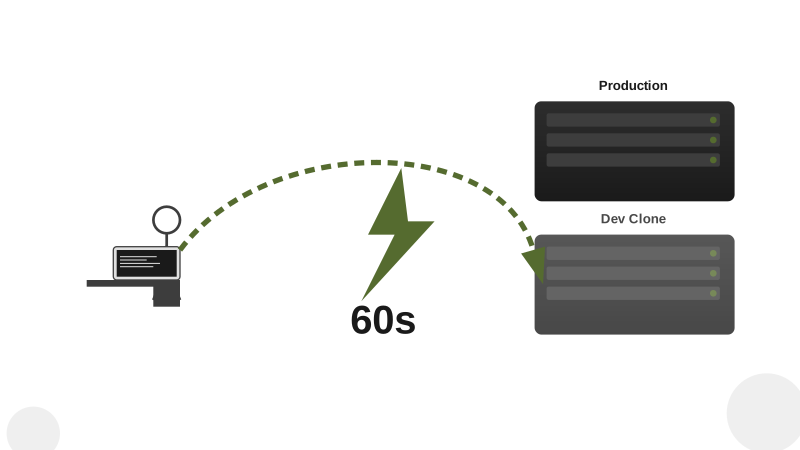
Clone your complete production infrastructure—apps, databases, configs, dependencies—with one click. Development teams get production-identical environments on demand while infrastructure costs drop by 60%.

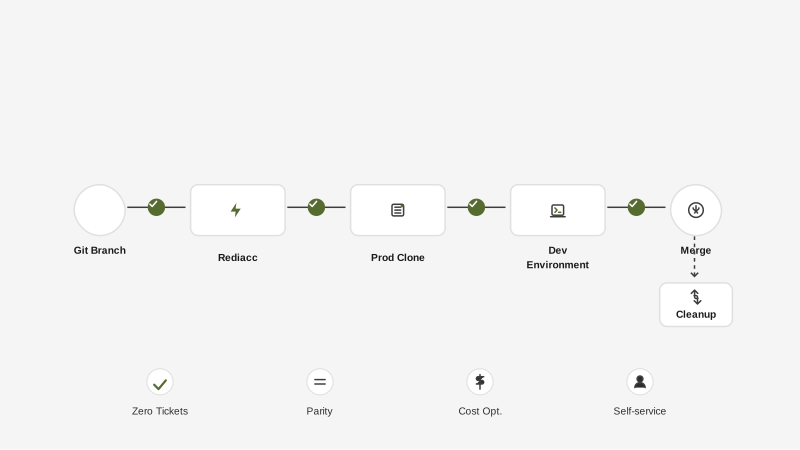
Development environment provisioning workflow showing instant production clones
1

The Development Environment Bottleneck

Time is what we want most, but what we use worst — William Penn
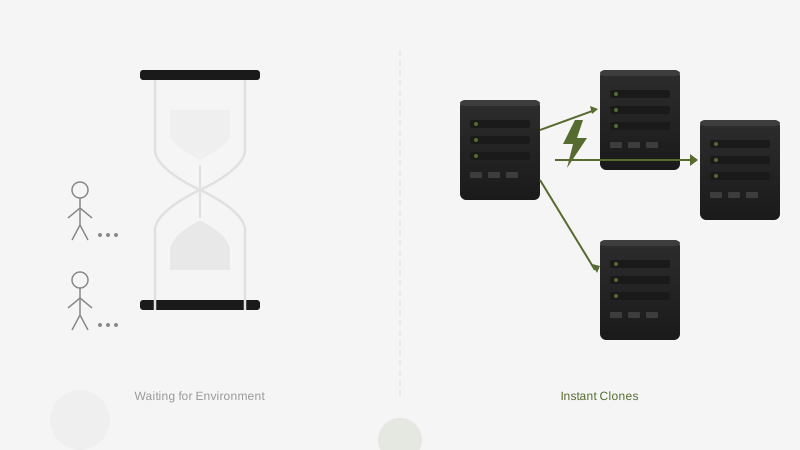
A mid-sized SaaS company with 30 developers calculated they wasted 21 hours per day across the team just waiting for environment setup. Each developer needed 30-45 minutes daily for environment configuration issues. That's 525 hours monthly—equivalent to 3 full-time engineers doing nothing but fighting infrastructure instead of shipping features. The cost: $150K+ annually in wasted developer time, not counting delayed features and missed market opportunities.

The Problem

Development teams waste 21+ hours every day waiting for environments. Manual setup requires DevOps intervention, multiple tickets, and days of waiting. By the time staging is ready, requirements have changed. This bottleneck kills velocity—61% of teams report environment provisioning as their major deployment roadblock. One in four organizations takes three-plus months from code complete to production deployment because environments can't keep pace.

  • Manual setup requires DevOps tickets creating 2-3 day delays
  • Each developer configures environments differently creating inconsistencies
  • Onboarding new developers takes 1-2 weeks just for environment setup
  • Context switching while waiting for environments kills productivity
  • DevOps teams become bottleneck handling provisioning requests

Instant Provisioning with Infrastructure Cloning

Rediacc provisions complete development environments in under 60 seconds through automated infrastructure cloning. Developers trigger environment creation directly from Git branches without tickets or manual intervention. The platform replicates your entire production stack—applications, databases, configurations, network topology, dependencies—as exact copies. Ephemeral environments automatically clean up when branches merge, preventing infrastructure waste. DevOps teams define provisioning rules once, then developers self-serve infinitely.

  • Provision complete environments in 60 seconds vs 2-3 days of waiting
  • Zero DevOps intervention—developers self-service from Git workflows
  • Automatic Git integration creates environments per branch automatically
  • Ephemeral architecture saves 40-70% on infrastructure costs
  • Onboard new developers in hours not weeks
2

The Production Parity Problem

An ounce of prevention is worth a pound of cure — Benjamin Franklin

A fintech startup deployed a critical payment feature that passed all staging tests. In production, it failed immediately—a database collation setting differed between staging and production, breaking payment processing. The issue went undetected because staging had drifted from production over months of manual changes. Result: 4 hours of downtime during peak trading hours, $200K in lost transaction fees, and a regulatory compliance inquiry. The fix took 5 minutes. Finding the environmental difference took 4 hours.

The Problem

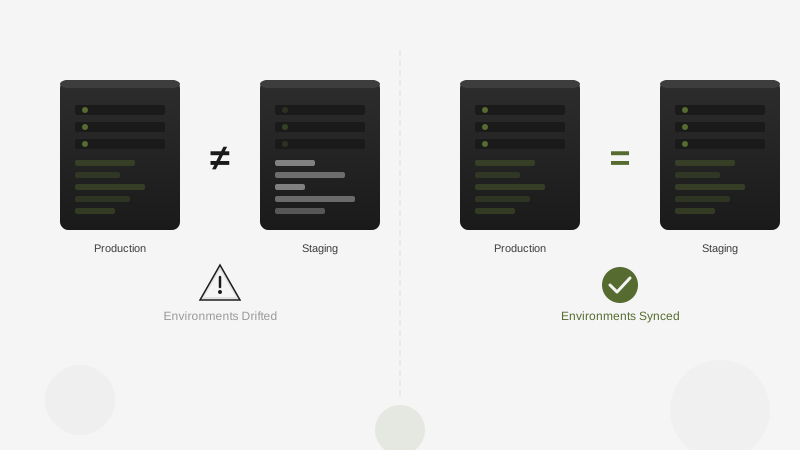
Staging environments drift from production through manual changes, version mismatches, and configuration decay. What works in staging fails in production. Developers spend hours debugging environmental differences rather than fixing actual bugs. This 'works on my machine' syndrome wastes 30+ minutes per developer per day troubleshooting inconsistencies. Environment parity becomes impossible when each developer manually configures local setups differently.

  • Configuration files drift through manual edits not tracked in Git
  • Database schema versions mismatch between environments
  • Dependency versions diverge causing 'works here fails there' bugs
  • Environment variables differ breaking integrations in production
  • No way to guarantee staging matches production exactly

Guaranteed Production Parity Through Point-in-Time Cloning

Rediacc eliminates drift by cloning production infrastructure at point-in-time, capturing exact application versions, database schemas, configuration files, and environment variables. Every clone guarantees production parity because it IS production—replicated atomically. Updates propagate automatically when production changes, keeping all environments synchronized. Developers work in containers or VMs that mirror production precisely, making 'it worked locally' synonymous with 'it will work in production.'

  • Atomic cloning captures complete system state ensuring consistency
  • Zero configuration drift—clones match production exactly by design
  • Automatic synchronization propagates production changes to all environments
  • Catch environment-specific bugs in development not production
  • Eliminate 30+ minutes daily per developer debugging environment issues
3

The Always-On Infrastructure Waste

Waste not, want not — English proverb

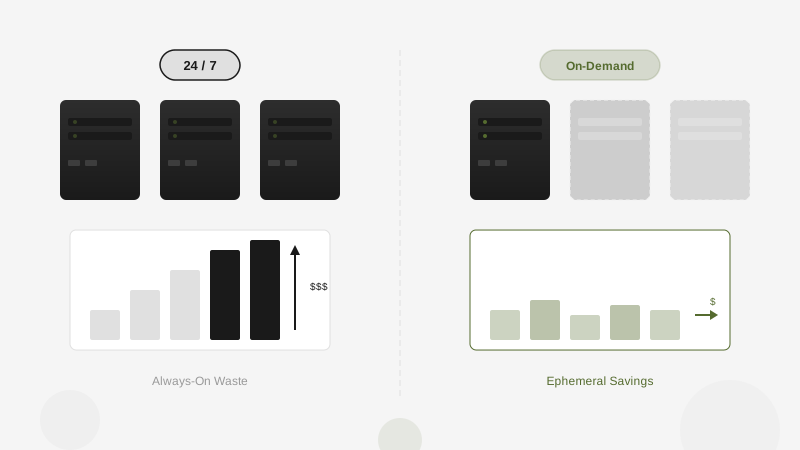
An e-commerce company with 50 developers reviewed their AWS bill: $180K monthly for development infrastructure. Analysis showed 78% of environments sat idle after business hours and weekends. Each environment ran full database copies—30TB total storage for data that could fit in 3TB with deduplication. They had 15 permanent staging environments, but only 3-4 were actively used at any time. The waste: $140K monthly on idle infrastructure that developers forgot to shut down.

The Problem

Traditional development infrastructure requires always-on staging, QA, and developer environments consuming cloud resources 24/7. Multiply environments across teams and costs explode. A 30-developer team maintaining standard dev/staging/QA setups easily burns $50K-100K monthly on idle infrastructure. Storage costs compound with full database copies consuming terabytes unnecessarily. Finance pressures engineering to cut infrastructure spending without understanding the velocity impact.

  • Always-on environments cost 24/7 but used 8-10 hours daily
  • Developers forget to shut down test environments after use
  • Full database copies multiply storage costs unnecessarily
  • Multiple staging environments 'just in case' sit idle most time
  • Infrastructure budget battles harm team morale and velocity

Ephemeral Environments with On-Demand Provisioning

Rediacc's ephemeral approach cuts infrastructure costs 40-70% through on-demand provisioning and automatic cleanup. Environments exist only when actively used—create for testing, destroy when done. Thin cloning technology eliminates storage duplication, provisioning 10TB databases from less than 1GB storage through copy-on-write mechanics. Teams pay only for compute during active usage, not for always-on infrastructure sitting idle overnight and weekends. The ROI calculator shows typical 30-person teams save $750K to $1.5M annually.

  • Reduce infrastructure costs 40-70% through ephemeral provisioning
  • Automatic cleanup when branches merge prevents environment sprawl
  • Thin cloning saves 90%+ storage with copy-on-write technology
  • Pay-per-use model charges only for active compute time
  • ROI payback typically within 3-6 months
4

The Integration Overhead

Simplicity is the ultimate sophistication — Leonardo da Vinci

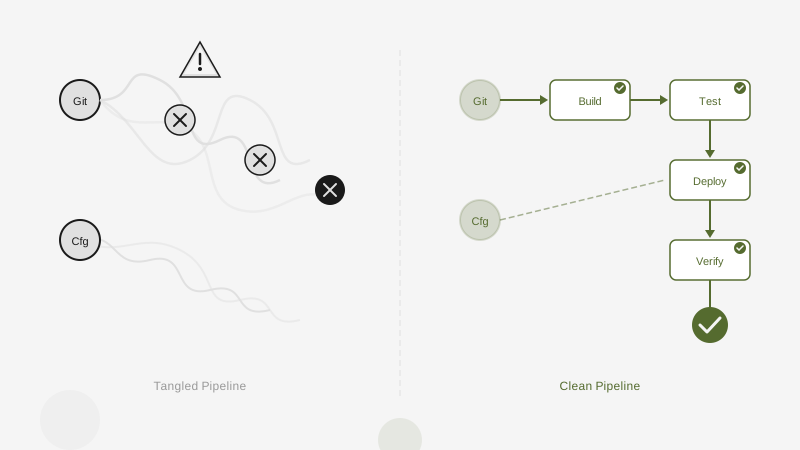
A B2B SaaS company attempted to automate environment provisioning through custom Jenkins scripts calling AWS CloudFormation and RDS APIs. Initial implementation took 3 months and 500 hours of DevOps engineering time. Six months later, when the original engineer left, nobody could modify the scripts safely. The provisioning system became technical debt—working but untouchable. When AWS deprecated an API endpoint, the entire pipeline broke. Recovery time: 2 weeks of lost development velocity while a consultant reverse-engineered the custom scripts.

The Problem

Adding environment provisioning to existing DevOps pipelines requires custom scripts, API integrations, and ongoing maintenance. Each new tool adds complexity to already-sprawling toolchains where 13% of teams juggle 14+ different tools. Integration failures break CI/CD pipelines. Documentation gaps mean only one engineer understands the provisioning system, creating knowledge concentration risk.

  • Custom integration scripts require ongoing maintenance
  • API changes break custom integrations without warning
  • Only one person understands the provisioning system
  • Each CI/CD platform needs different integration approach
  • Tool sprawl increases cognitive load and failure points

Native CI/CD Integration with Infrastructure-as-Code Support

Rediacc integrates with your existing stack through native plugins for GitHub, GitLab, Bitbucket, Jenkins, CircleCI, and major CI/CD platforms. Provisioning triggers automatically on PR creation or manual command. Infrastructure-as-code definitions using Terraform, Kubernetes, Docker Compose, or CloudFormation work unchanged. The platform complements rather than replaces existing tools—your development workflow stays familiar while environment provisioning becomes automatic. Setup takes minutes not weeks, and every engineer can provision environments without specialized knowledge.

  • Native integrations for all major Git platforms and CI/CD tools
  • Infrastructure-as-code compatibility with Terraform Kubernetes Docker
  • Zero workflow disruption—works with existing development processes
  • Automatic provisioning on PR creation or Git events
  • Setup in minutes vs weeks of custom integration development
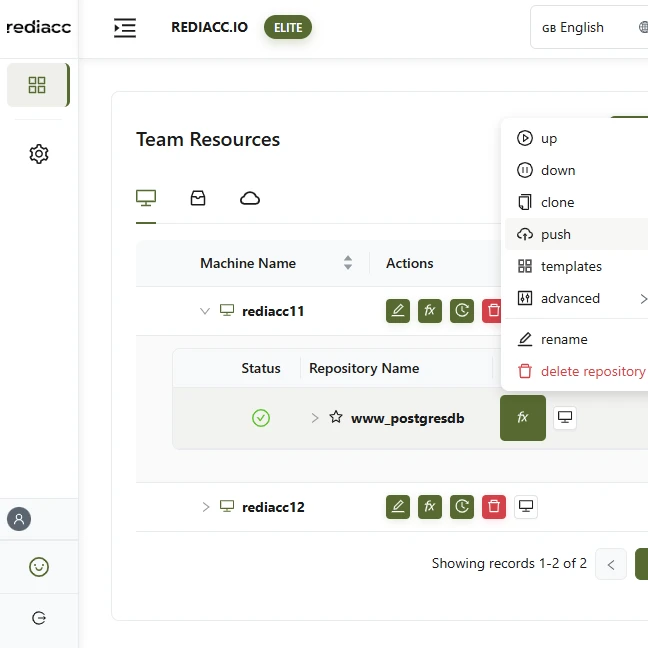
Development environment automation dashboard showing ephemeral environments and cost savings
Rediacc development environment resources

Ready to Accelerate Development?

Clone your first environment in seconds. Limited spots available.

Apply for Early Access