Fork or move a running Kubernetes cluster
The cluster moves as one set: nodes, config, and data. To another machine or another datacenter. The cutover is measured in seconds, not a weekend.
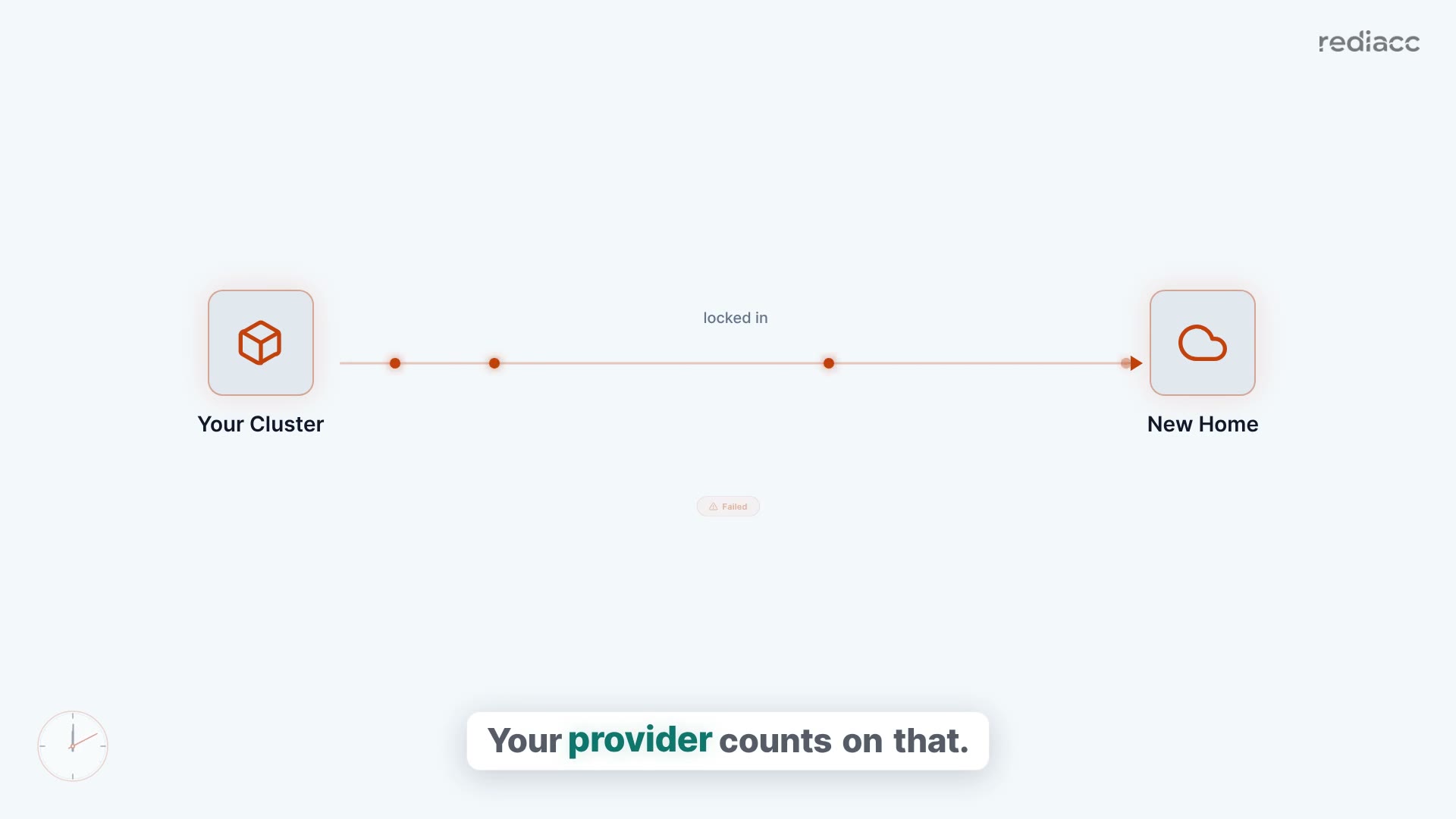
The cluster is stuck where it was built
Kubernetes made the apps portable. The cluster itself is not. The data lives in one datacenter. Moving it means a rebuild project: new nodes, new storage, restore from backup, retest everything. So most teams never move. And their provider knows it.
See the timeline
The whole cluster is one set of files
Cluster images plus volumes
Each node runs from an image file. Each volume is a Ceph RBD image. Together they are the whole cluster: apps, config, and data.
Fork in place
One command clones every image, copy-on-write. A 2-node cluster forked in 46 seconds in our lab. The parent keeps running.
Migrate with a short cutover
Rediacc pre-copies while the cluster runs. Then it stops, sends the final delta, and restarts on the new machine. Measured cutover: 16 seconds.
Why a cluster can move like a file
Every node runs from an image file on btrfs. Every volume is a Ceph RBD image. Copying a cluster means cloning those images, copy-on-write. No export, no conversion, no restore step. That is why a fork takes seconds, not months.
Why a cluster can move like a file
| Backup-and-restore migration | Rediacc (copy-on-write clone) |
|---|---|
| Backup tools restore into an empty cluster, piece by piece | Node images and volumes move as one set |
| Data needs a separate replication product | Ceph RBD clones ride along, copy-on-write |
| A cluster clone means re-provisioning and redeploying | A 2-node cluster fork took 46 seconds in our lab. The parent keeps running |
| Cutover plans span a weekend | Measured cutover: 16 seconds. Workloads restart on the destination |
Keep Kubernetes. Gain mobility.
Keep Kubernetes
Rediacc runs k3s, or connects to an existing cluster. Volumes ride on ceph-csi RBD. The manifests never change.
Real datacenter mobility
Provision on local KVM hosts or on clouds like Linode with private VLANs. Node pools keep disk-heavy Ceph nodes apart from cpu-heavy Kubernetes nodes.
One mentality for everything
A Kubernetes app is a namespace. Fork it like any repo: 1 to 5 seconds, data included. Same commands as any Docker repo.
Short on time?
Skip the deep-dive. Grab the five-minute version, short enough to read at a stand-up.
Download short brief (PDF)Nobody else moves a running cluster with its data
Backup tools stop and restore. Cluster API clones the shape without the data. RBD mirroring copies volumes, not the cluster. Rediacc moves all of it.
Nobody else moves a running cluster with its data
| Capability | Velero | Kasten K10 | Cluster API | RBD Mirroring | Rediacc |
|---|---|---|---|---|---|
| Backs up apps and volumes | ✓ | ✓ | ✗ | Volumes only | ✓ |
| Moves a whole cluster with its data | Stop and restore | Stop and restore | Shape only | ✗ | ✓ |
| Forks a running cluster, data included | ✗ | ✗ | ✗ | ✗ | ✓ |
| Clones one app (namespace) in seconds | ✗ | ✗ | ✗ | ✗ | ✓ |
| Copies data without a full rewrite | ✗ | ✗ | ✗ | Async copy | ✓ |
| Short measured cutover for a planned move | ✗ | ✗ | ✗ | ✗ | ✓ |
Sources(10)
- Flexera, "2024 State of the Cloud Report," 2024. "27% of cloud spend continues to be wasted."
- Flexera, "2025 State of the Cloud Report," 2025. "With cloud budgets already exceeding limits by 17%, organizations are increasingly turning to managed service providers."
- AWS, "Amazon S3 Pricing: Data Transfer," 2024. "Data Transfer OUT from Amazon S3 to Internet: $0.09 per GB for the first 10 TB/month."
- Velero backs up Kubernetes cluster resources and persistent volumes and restores them into a cluster.
- Kasten K10 provides backup and restore of Kubernetes applications, including application data.
- Velero cluster migration restores a backup into a new cluster; workloads are recreated from the backup point, not moved live.
- Kasten K10 migrates applications between clusters by exporting a restore point and importing it into the target cluster.
- Cluster API's clusterctl move relocates Cluster API objects (the cluster's definition) to another management cluster; it does not move workload data.
- Ceph RBD mirroring replicates block device images between Ceph clusters; it covers volumes, not Kubernetes cluster state.
- Ceph RBD mirroring is asynchronous, based on journaling or periodic snapshots, and is designed for disaster recovery.
Explore Other Solutions
Give the cluster an exit route
Fork it, test the move, then migrate for real. Start the 14-day free trial.
Start free trial