When AWS goes down, the business stays up
Apps run across more than one cloud. When one cloud goes down, the others take over on their own. Nobody gets paged.
Single-cloud is a single point of failure
Picture this: AWS us-east-1 goes dark and the whole business goes dark with it. The site, the sales, the support line. All down, and there is nothing to do but wait. Big cloud outages rose 18% year-over-year in 2024. They lasted 18.7% longer. Human error caused 68% of them. Betting on one cloud means betting the business on someone else’s bad day.
See the timeline
What does a cloud outage cost?
Drag the sliders to match the business. See the real cost of single-cloud dependency.
One command. Always online.
Replicate
Run one command: rdc replicate production --target secondary. Only the data that changed moves, not the whole thing. So it stays fast and cheap.
Monitor
Rediacc checks the primary site around the clock. The moment it fails, we know. It plugs into existing tools like Grafana and Prometheus.
Failover
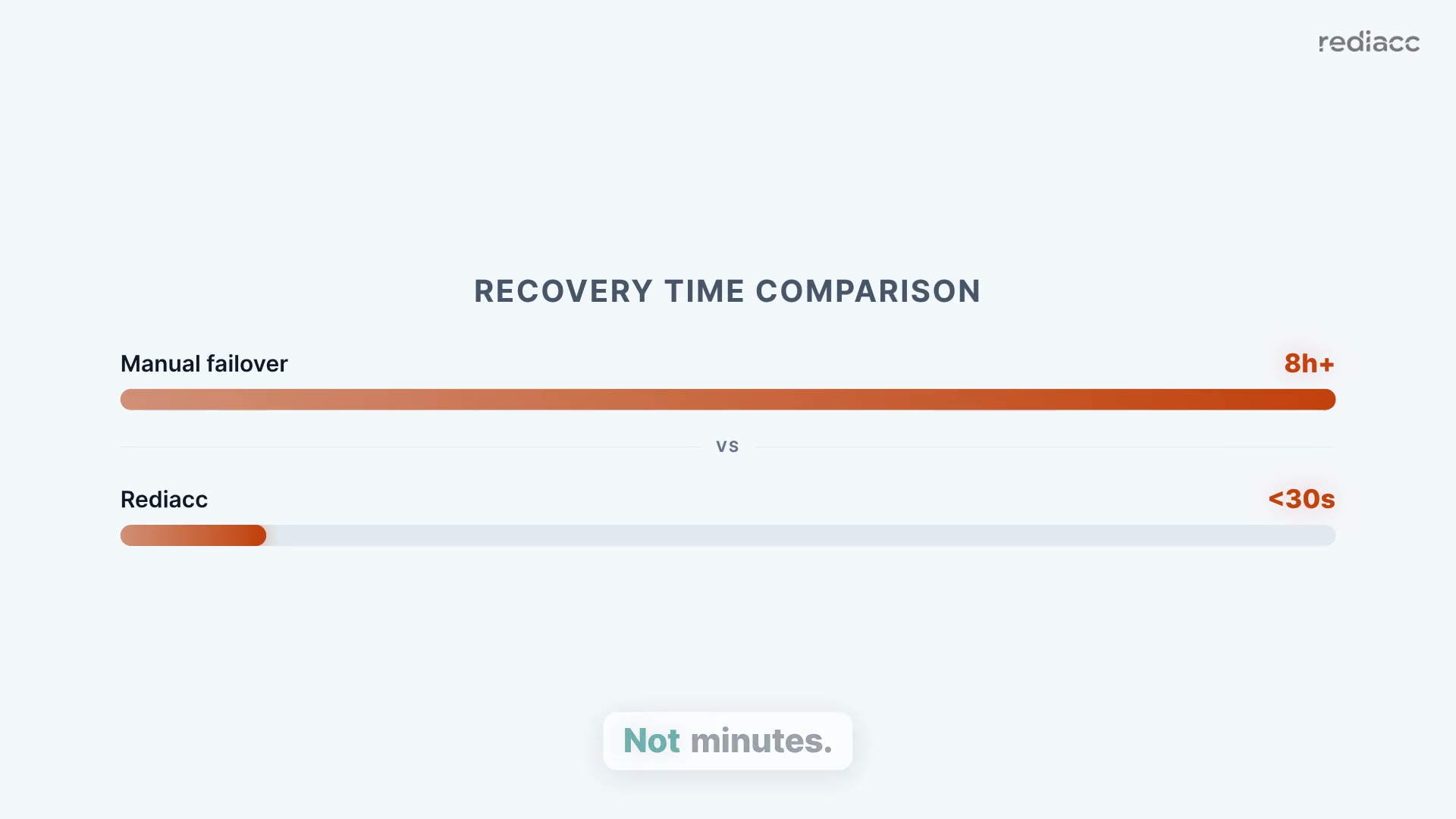
Traffic moves to a healthy site in under 30 seconds. DNS updates on its own. No manual step.
Why cross-cloud replication is fast and cheap
Rediacc only copies the data that changed since last time. Take a 380 GB setup where 2.4 GB changes today. Rediacc moves 2.4 GB, not 380 GB. That cuts bandwidth by 98%. It can run all the time or on a schedule.
Why cross-cloud replication is fast and cheap
| Traditional approach | Rediacc (btrfs send/receive) |
|---|---|
| Copies the full server image: 380 GB every sync, takes hours | Copies only what changed: about 2.4 GB a day |
| Locked to one vendor (AWS to AWS, Azure to Azure) | Works anywhere: any Linux machine to any Linux machine |
| Manual DNS switch: 15-60 minutes of engineer time | Automatic health check and DNS switch in under 30 seconds |
| Data-out fees: $0.09/GB, ~$34/sync for 380 GB full image | Data-out fees: $0.09/GB, ~$0.22/sync for 2.4 GB incremental diff |
What it includes
Always online
One cloud fails and another takes over. No one has to step in. The switch fires the moment a health check fails. It hooks into the monitoring tools already running.
More than one cloud by default
AWS, Azure, GCP, Hetzner, or bare metal. Mix and match freely. Any Linux machine with our storage engine can be a backup target. Whole Kubernetes clusters can move too, with a short cutover.
No vendor lock-in
Move between clouds at any time. The saved copies use an open format. No locked-in agents. It is standard btrfs, built into Linux since 2013.
Short on time?
Skip the deep-dive. Grab the five-minute version, short enough to read at a stand-up.
Download short brief (PDF)No other tool fails over across clouds in seconds
Cloud-built tools only copy data inside their own cloud. Backup tools take hours to restore. Rediacc copies across any provider and fails over in under 30 seconds.
No other tool fails over across clouds in seconds
| Capability | AWS Backup | Veeam | Zerto | Druva | Rediacc |
|---|---|---|---|---|---|
| Copies across clouds | ✗ | ✓ | ✓ | ✓ | ✓ |
| Failover under 30 seconds | ✗ | ✗ | ✗ | ✗ | ✓ |
| Sends only changes (98% savings) | ✗ | ✓ | ✓ | ✓ | ✓ |
| Fail over from any provider to any other | ✗ | ✗ | ✗ | ✗ | ✓ |
| Self-hosted, no cloud agent | ✗ | ✓ | ✓ | ✗ | ✓ |
| Automatic DNS failover | ✗ | ✗ | ✓ | ✗ | ✓ |
| Copies the whole stack (app and database) | ✗ | ✓ | ✓ | ✗ | ✓ |
Sources(14)
- ITIC, “2024 Hourly Cost of Downtime Report,” 2024. “The average cost of a single hour of downtime now exceeds $300,000 for over 90% of mid-size and large enterprises.”
- Parametrix, “2024 Cloud Outage Risk Report,” 2024. “Critical cloud service interruption events increased by 18.0% and lasted 18.7% longer in 2024 than in 2023. Human error accounted for 68% of incidents.”
- Splunk & Oxford Economics, “The Hidden Costs of Downtime,” 2024. “The total cost of downtime for Global 2000 companies is $400B annually, or 9 percent of profits, when digital environments fail unexpectedly.”
- Veeam supports cross-cloud backup and replication between VMware, Hyper-V, AWS, Azure, and Google Cloud.
- Zerto replicates workloads between VMware, Hyper-V, AWS, Azure, IBM Cloud, and 350+ cloud service providers.
- Druva provides cross-cloud DR by storing backup data across AWS and Azure from a single console.
- Veeam uses incremental backup with Changed Block Tracking (CBT) to transfer only modified data blocks.
- Zerto VRAs continuously replicate only changed data blocks at the hypervisor level in near-synchronous fashion.
- Druva uses incremental-forever backup with global variable-block deduplication achieving up to 90% bandwidth savings.
- Veeam Backup & Replication is deployed on-premises on Windows Server with full customer control over infrastructure.
- Zerto is deployed on-premises with a Zerto Virtual Manager and per-host Virtual Replication Appliances.
- Zerto provides automated Re-IP of recovered VMs during failover with pre/post recovery scripts for DNS updates.
- Veeam Backup & Replication provides continuous replication of full application stacks with orchestrated failover.
- Zerto Virtual Protection Groups replicate multi-VM application stacks as a single consistent unit with write-order fidelity.
Explore Other Solutions
Don’t bet the business on one cloud
Copy data across sites. Start the 14-day free trial.
Start free trial 14-day free trial · Cancel anytime