Recover in minutes. Not days.
When ransomware hits, every minute costs money. Rediacc restores service fast, before the damage spreads.
Slow recovery costs more than the attack
It's 2 AM. Ransomware just locked the servers. Now come days of rebuilding from scratch. Customers can't get through. Revenue stops. Trust breaks. The attack took an hour. The cleanup takes a week. That's the real damage. The average ransomware recovery takes 24 days.
What does slow recovery cost?
Drag the sliders to match the situation. The damage adds up every minute.
One command. Back online.
Detect
Run rdc backup list to find the last clean backup.
Select
Pick the exact moment before the attack. Down to the minute.
Restore
The full system is back online in under 5 minutes. Every container, all the data, all the settings.
Why recovery takes minutes, not days
Old recovery rebuilds everything from scratch: reinstall the system, restore files, set up services again. Rediacc works differently. A clean copy already sits on the disk. We just flip it on. No reinstall, no setup, no slow data transfer.
Why recovery takes minutes, not days
| Traditional rebuild | Rediacc (btrfs instant copies) |
|---|---|
| Reinstall the system and software: 2-4 hours per server | Clean copy already on disk: switch to it in seconds |
| Restore backup from far-away storage: hours to days for big datasets | Local copy, no data transfer: restore 500 GB in under 60 seconds |
| Set up network, services, and SSL again by hand: easy to get wrong | Whole-system copy: network, services, and SSL all included |
| Check by hand after restore: hope nothing was missed | Automatic health check after restore: 8/8 services confirmed running. The copy keeps the evidence while the restore runs. |
Short on time?
Skip the deep-dive. Grab the five-minute version, short enough to read at a stand-up.
Download short brief (PDF)No other tool recovers this fast
Old backup tools restore files. Rediacc restores a whole system in minutes. Containers, settings, and databases all come back together.
No other tool recovers this fast
Sources(18)
- Coveware, "Quarterly Ransomware Report Q2 2022," July 2022. "In Q2, the average days of downtime was measured at 24 days, a decrease of 8% from Q1 2022."
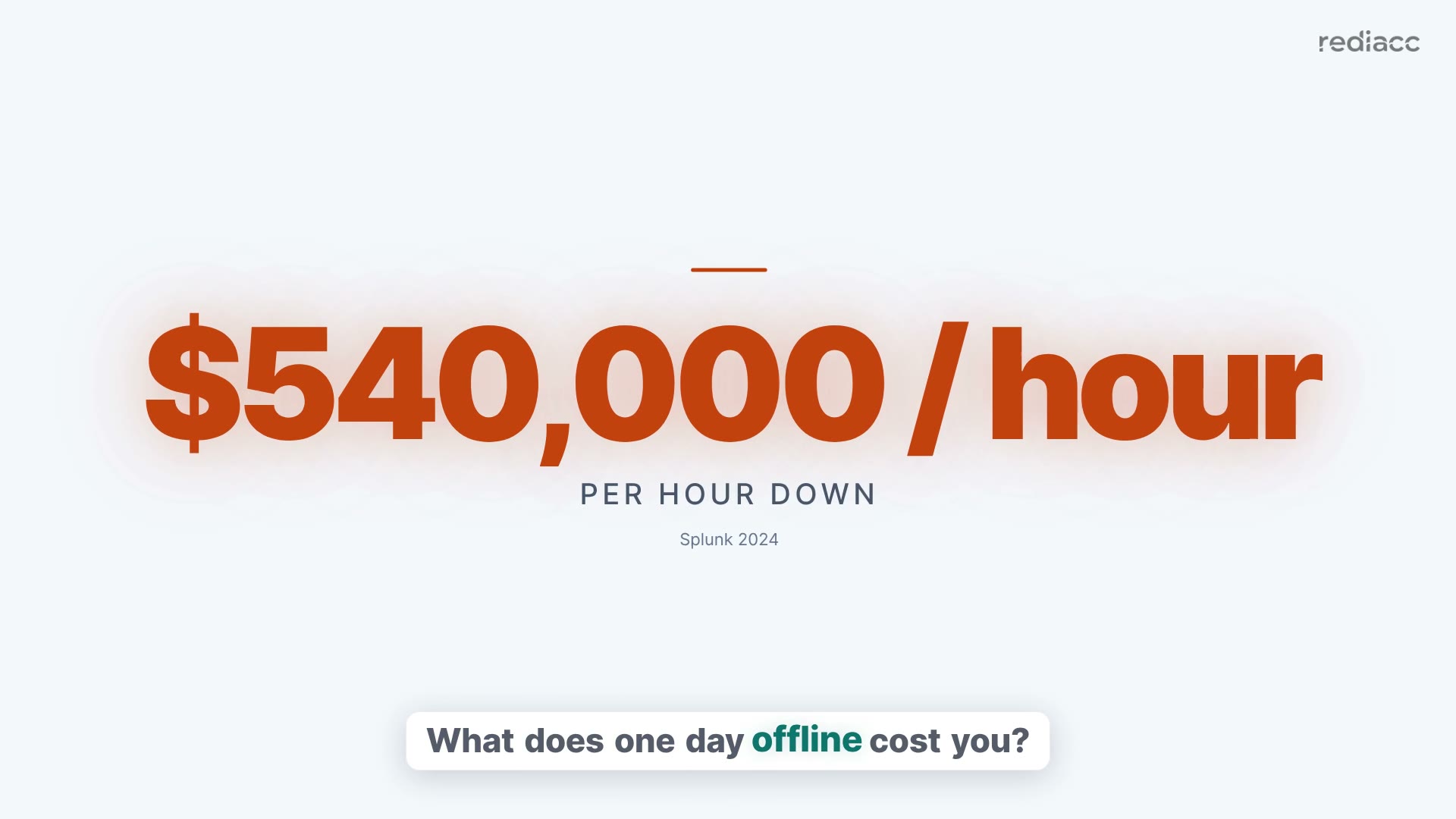
- Splunk & Oxford Economics, "The Hidden Costs of Downtime," June 2024. "Each minute of downtime costs $9,000 or $540,000 per hour."
- Cybereason, "Ransomware Attacks and the True Cost to Business 2022," 2022. "80% of organizations that paid were hit by ransomware a second time, with 68% saying the second attack came less than a month later and threat actors demanded a higher ransom amount."
- Zerto continuous replication with journal-based recovery delivers near-zero RPO and minutes-level RTO for instant recovery.
- Veeam Instant VM Recovery enables sub-5-minute RTO by booting VMs directly from backup files.
- Rubrik Instant Recovery enables sub-5-minute recovery by mounting VMs directly from immutable snapshots.
- Commvault Live Recovery enables sub-5-minute RTO by mounting VMs from backup with background Storage vMotion.
- Druva Instant Restore minimizes downtime with sub-5-minute VM recovery directly from backup cloud storage.
- Zerto's always-on replication with sub-10-second RPOs and minute-level RTOs enables near-instant full-environment recovery.
- Veeam supports per-VM snapshot-based restore points with configurable backup schedules and continuous data protection.
- Rubrik provides SLA-driven snapshot policies with configurable frequency for granular point-in-time recovery.
- Commvault supports point-in-time recovery using snapshots for VMs, file servers, databases, and applications.
- Druva maintains hot, warm, and cold recovery points enabling point-in-time restores of VMs, databases, and SaaS apps.
- Zerto journal stores every block-level write creating crash-consistent checkpoints every 5-10 seconds for granular recovery.
- Veeam Backup & Replication is deployed on-premises on Windows Server with full customer control over infrastructure.
- Rubrik is deployed as on-premises appliances (r6000 series) with integrated compute, storage, and software.
- Commvault supports fully self-hosted on-premises deployments with CommServe, MediaAgent, and Access Node components.
- Zerto is deployed on-premises with a Zerto Virtual Manager and per-host Virtual Replication Appliances.
Explore Other Solutions
Don't let recovery be slower than the attack
Protect the production servers. Start the 14-day free trial.
Start free trial