Skip to main content Skip to navigation Skip to footer
PREEMPTIVE DEFENSE

Fix vulnerabilities before attackers arrive

Find, test, and patch security gaps on safe clones. Deploy fixes to production with confidence.

Every security tool finds vulnerabilities. None let you test the fix on a real clone first. Rediacc does.

$ rdc term production cve-2026-1234-fix
Cloning production environment .. done (47s)
→ Clone: prod-vuln-fix-1234 (380 GB, btrfs CoW: 2.1 GB)
Applying patch: OpenSSL 3.0.8 → 3.0.15 .. done
Restarting affected services .. done (12s)
→ Keycloak restarted · Nextcloud restarted · GitLab restarted
Running verification suite ....
→ CVE-2026-1234 re-scan: PATCHED
→ Service health checks: all passing
→ Regression tests (247 assertions): 0 failures
→ TLS handshake verification: valid
✓ Patch verified. Safe to deploy to production.
Time: 3m 41s    CVE: patched    Services: 3/3 healthy

Illustrative output; actual runs may include extra logs. CLI reference: rdc term

<4min
Patch + verify time
Safe
Test before deploy
0
Unverified patches
THE PROBLEM

Patching in production is a gamble

You found a vulnerability. Now you need to patch it. But will the patch break something? You can’t test in production. And your staging environment is 3 weeks behind. So you either rush the patch and hope, or wait and stay exposed. Neither option is good — and both cost money.

30.6 days mean time to remediate weaponized vulnerabilities Qualys TruRisk Research Report 2023 [1]
180% increase in vulnerability exploitation as initial breach vector Verizon DBIR 2024 [2]
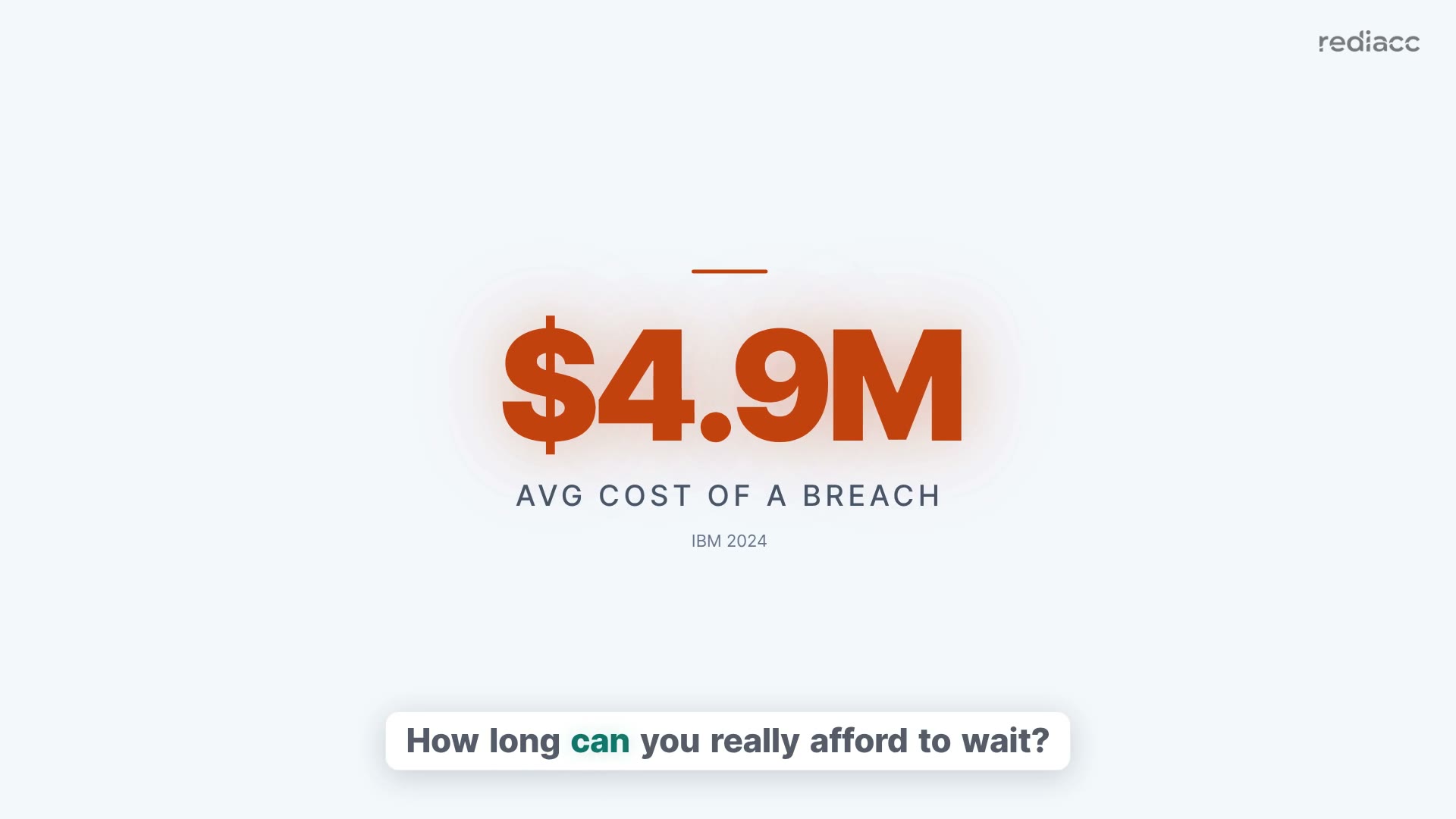
$4.88M average cost of a data breach IBM Cost of a Data Breach 2024 [3]
Traditional patching
Day 1 CVE disclosed
Week 1-2 Assess impact
Week 3-4 Test on staging
Week 5 Schedule window
Reality Patch breaks prod
With Rediacc
Clone + patch
<4 min
Verified
Deploy
THE REAL COST

What’s slow patching costing you?

Every day a vulnerability sits unpatched is a day you’re exposed. Every rushed patch risks a production incident.

Remediation cost calculator

Without Rediacc
Exposure per vuln21 days
Failed patches / year15
Remediation labor$63,000
Annual remediation cost
$138,000
With Rediacc
Exposure per vuln1 day
Failed patches / year0
Remediation labor$18,000
Annual remediation cost
$22,800
Model: Traditional remediation labor at $150/hr avg (security engineer time for impact assessment, staging setup, testing, rollback). Failed patches estimated at 25% based on industry experience. Rediacc reduces fix time to <1 day with clone-based verification, eliminating patch failures.
HOW IT WORKS

One command. Verified fixes.

1

Detect

Automated scan identifies a vulnerability — CVE, misconfiguration, or exposed service. Prioritized by severity.

2

Clone + Patch

Clone production in 47 seconds. Apply the fix on the clone. Run full regression tests against real data and configs.

3

Verify + Deploy

Confirm the vulnerability is patched and nothing else broke. Deploy to production with confidence. Destroy the clone.

CVE-2026-1234 Critical
OpenSSL 3.0.8 — VULN
Keycloak :8443 — affected
Nextcloud :443 — affected
GitLab :443 — affected
47s + 2m
Clone: Patch Test Testing
OpenSSL → 3.0.15 — APPLIED
Keycloak restart — healthy
Nextcloud restart — healthy
247 assertions — 0 failures
verified
Production Patched
OpenSSL 3.0.15 — FIXED
CVE-2026-1234 — PATCHED
3/3 services — healthy
0 regressions — verified
UNDER THE HOOD

Why clone-based patching works

Traditional patching requires a staging environment that matches production — but staging drifts within days. Rediacc creates a btrfs copy-on-write snapshot of your actual production infrastructure in seconds, lets you apply and verify the patch against real data and real configs, then deploys the verified fix to production. If the patch fails verification, discard the clone. Production stays untouched.

Traditional patching
Rediacc
Staging (weeks old, config drift)
Production clone (seconds old, 100% match)
Days to weeks (staging setup + testing)
Under 4 minutes (clone + patch + verify)
Untested patches risk unintended disruptions
0% — failures caught on clone, discarded
Hope the rollback script works
Destroy clone, production never changed
WHY IT MATTERS

What you get

Safe patching

Test every fix on an exact production clone before deploying. If the patch breaks something, discard the clone. Production untouched.

Same-day remediation

From CVE disclosure to verified production patch in under 4 minutes. No more month-long exposure windows.

Full verification

Every patch runs through CVE re-scan, service health checks, regression tests, and TLS verification — all on real production data.

A critical CVE dropped on a Friday afternoon. By Saturday morning we’d cloned production, applied the patch, verified it against all 4 affected services, and deployed — zero downtime. Our previous process would have taken 3 weeks and a change management meeting.
Patch + verify + deploy time

Patch faster. Patch safer.

Start with the free Community edition. Verify your first patch in under 4 minutes.

Start Free No credit card required
$ rdc term production cve-2026-1234-fix
Test any containerized workload
Databases, mail servers, CI/CD, CMS, monitoring, auth — if it runs in a container, Rediacc can clone, patch, and verify it.
Sources & References
  1. Qualys, “TruRisk Research Report,” 2023. “On average, weaponized vulnerabilities are patched within 30.6 days yet only patched an average of 57.7% of the time.” www.qualys.com
  2. Verizon, “2024 Data Breach Investigations Report,” May 2024. “The exploitation of vulnerabilities as an initial point of entry almost tripled from the previous year, accounting for 14% of all breaches.” www.verizon.com
  3. IBM Security, “Cost of a Data Breach Report,” July 2024. “The global average cost of a data breach reached USD 4.88 million in 2024.” newsroom.ibm.com
Product performance claims are based on Rediacc’s btrfs copy-on-write architecture. Calculator estimates use industry-standard cost models; actual costs vary by organization.