Plug into the existing workflow
Push the code. Rediacc spins up a fresh copy of production. Tests run on real data, not fake data. No custom scripts to write.
Custom CI/CD scripts break and no one maintains them
Someone wrote a 200-line script to build test environments in the pipeline. Then they left the company. Now the script breaks every month, and nobody understands it. The pipeline runs on duct tape and hope.
What broken CI/CD really costs
Every test that passes on synthetic data but fails in production is a CI pipeline that lied.
One command. Zero scripts.
Connect
Add one line to the Git config. Works with GitLab CI, GitHub Actions, or any system that can send a webhook.
Trigger
Every push makes a fresh copy of production on its own. Real data. Real settings. Real services.
Test
Tests run on a copy that matches production exactly. The copy deletes itself when the tests finish.
Custom scripts vs. built-in integration
Most CI tools spin up empty containers and fill them with fake data. Rediacc works deeper, at the server level. Every push gets a full copy of production: real data, real settings, real services.
Custom scripts vs. built-in integration
| Custom CI Scripts | Rediacc |
|---|---|
| 200+ lines of bash setup scripts | One webhook line. Zero custom scripts. |
| Fake test data that doesn’t match production | Real production data from an instant copy |
| 15 to 30 min to set up a test environment | 52 seconds to copy an entire production stack |
| Manual cleanup, forgotten environments | Automatic cleanup after pipeline completes |
Short on time?
Skip the deep-dive. Grab the five-minute version, short enough to read at a stand-up.
Download short brief (PDF)Fake test data vs. production copies
Every CI platform can spin up containers. None deliver a real copy of production with real data.
Fake test data vs. production copies
Sources(12)
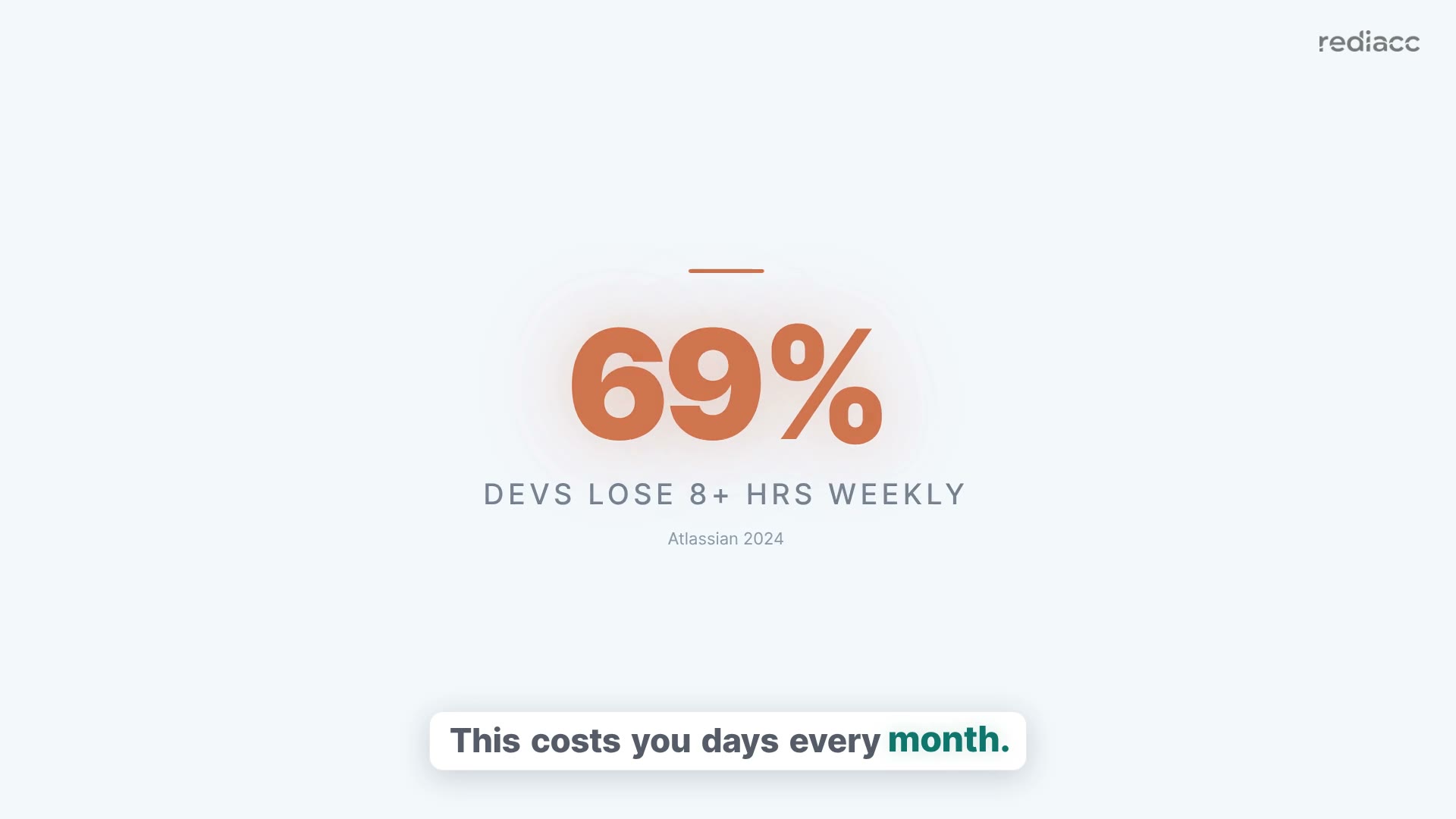
- Atlassian, DX & Wakefield Research, "State of Developer Experience Report," 2024. "Sixty-nine percent of developers are losing eight hours or more per week to inefficiencies." "For an organization with 500 developers, losing 8 hours per week costs roughly $6.9 million over the course of a year."
- DORA (Google Cloud), "Accelerate State of DevOps Report," 2024. "Elite performers deploy 182 times more frequently than their low-performing peers."
- GitHub webhooks deliver HTTP POST payloads for codespace lifecycle events enabling CI/CD integration.
- Vercel webhooks support deployment, project, and domain events; deploy hooks trigger deployments from external systems.
- Railway webhooks notify applications of deployment status changes across all environments.
- Coder templates extend with Docker Compose and Terraform for multi-service CI environments with databases and caches.
- Railway Focused PR Environments deploy only affected services for optimized multi-service CI.
- Stopped codespaces are automatically deleted after a configurable retention period (0-30 days, default 30).
- Vercel deployment retention policies auto-delete deployments after a configurable period.
- Vercel Zero Config works for any framework with a build script requiring no additional configuration.
- Railway uses Nixpacks for zero-configuration builds that auto-detect language and dependencies.
- Coder is a self-hosted open-source (AGPL v3.0) platform deployed in private data centers or cloud services.
Explore Other Solutions
Simplify the CI/CD pipeline
Git integration is built in. Start the 14-day free trial.
Start free trial 14-day free trial · Cancel anytime